
so you're scared of how deep your grief goes

hello, friends. i've shared a lot about grief over the last few years, including a series of FLOW essays, a lot of grief-centered tarot spreads, and a personal essay on grief and gratitude on my 40th birthday. over the next week or two i'm going to offer thoughts on a few sticky things that tend to come up again and again when i talk to folks about grief work, in the hopes that i can make this transformative practice feel a bit more accessible. you can read the first essay in this series here.
in part, this is because my ten-week collective grief program river styx begins on october 4th (click here to join the waitlist!). but even if you don't participate in that container, grief work is something that is worth thinking about, worth engaging with, worth considering. my hope is that this little mini series can offer you a gentle path into grief work, a lantern to light your way, and a warm hand to hold as you go.
take a deep breath, and let it out slowly. let's get into it.
how deep is your grief?
for a lot of us, grief can feel bottomless, fathomless, like there is no end in sight or container that could possibly hold it all. our grief feels so big, so heavy, that we can't even really conceptualize it — it's overwhelming in its density. and what that can mean is that when we think about diving into our grief, it can feel like we'll just get sucked into the depths, lost in the darkness, with no idea how to touch the floor or how to find our way back to the surface.
and frankly, that sounds terrifying.
of course you don't want to wade into something you can't wrap your head around. of course you're not eager to dive headfirst into something that feels so impossibly big that you'd get completely turned around. of course you'd rather do everything you can to avoid even getting wet, let alone immersing yourself fully.
compartmentalizing our grief is a survival mechanism that a lot of us employ, simply so that we can get through the fucking day. and it's not hard to understand why: the news is constant and catastrophic; there's an endless stream of violence and hideous government decisions and human-made disasters; every day here in the united states we get a new food recall or learn about something else that's about to skyrocket in price. simply surviving is a full-time job — why on earth would we want to spend the precious little extra time that we have dealing with something as scary, as bottomless, as overwhelming, as grief?
i'm gonna be honest with you — you might not want to. you might think i'm a little nuts for even suggesting it, and i do get it. you might be kinda sick of me even talking about grief. i know how this sounds, and i'm also exhausted. i understand.
but the reality is that whether you want to deal with it or not, your grief is going to be there anyway: keeping you company, impacting how you process information and make choices, slowing you down, narrowing your scope. your grief is along for the ride, even if you're really good at compartmentalizing or tucking it all away. and if the idea of acknowledging your grief, dealing with your grief, or actually engaging with your grief scares the shit out of you, well — that's what i'm here for.
grief work doesn't have to mean just diving headfirst into an abyss so deep you'll never escape. it means learning how to float, and how to flow. let me show you.
much like grief, the ocean is huge, and mysterious, and gets real scary the longer you think about it. you might agree with the brilliant zach reino's smartypants presentation, that when it comes to the ocean, "we don't know what's in there, and we shouldn't find out."
for so many, avoiding and ignoring the grief that we carry is highly preferable to diving into that deep, dark, unknowable place — especially if we don't have a buddy, or a life raft, or whatever other water-related supports you wanna bring into this metaphor. it seems easier, safer, to lock it up tight and deny its existence rather than risk dipping our toes in and getting sucked into the depths.
i'm not judging you. i've been there myself.
you've probably noticed that i love a water analogy for grief. like water, grief can sometimes feel crystal clear and without artifice, and can sometimes feel murky and dark, rough and choppy, like it could pull you under at any moment. sometimes grief feels like a storm, wild and feral and out of control — but sometimes grief feels like gentle rain, or reliable waves, or morning dew.
grief changes, all the time. it can be quietly devastating or loudly absurd, leaving us laughing and crying and shaking and frozen simultaneously. whether navigating a personal loss or grappling with the collective trauma we are all experiencing in various ways, grief has a way of feeling unpredictable, even when we rationally understand why we feel the way we do.
the water metaphor is particularly helpful because within a container, within a structure, within limits, water is a little easier to control. sure, sometimes there are leaks and cracks, floods and fissures — but without any kind of container, water simply fills up whatever space its in, eventually overflowing when it becomes too much. but as i wrote earlier this year in my four of cups essay, "water can be protected, guided, preserved, and channeled, brought where we need it in a steady and reliable way." it's not about having absolute power over water (or over our grief and other heavy emotions) — it's about directing it, supporting it, safeguarding it, and recognizing how heavy and strong it really is.
when we treat grief like an ocean, it becomes too impossibly big to navigate, too overwhelming to engage with. if we abandon grief like an old well, it stagnates, rots, becomes something fetid and untouchable. but if we allow grief to be a river, it flows and moves, helping us travel somewhere instead of staying stuck.
i want your grief to be a river, friend. i want you to find some flow. i want you to be able to breathe freely, instead of trying to pretend that you aren't drowning on dry land. and i want you to learn to let your grief move through you, so that you can move too.
it's okay to be scared of your grief. it's normal to be afraid of it, to feel overwhelmed by it, to hide from it like some awful boogeyman.
but friend, i say this with love: your grief is much more likely to consume if you if you ignore it. talking to it, acknowledging it, holding it tenderly, and giving your grief what it needs is actually the best way to move it through you, to befriend it, to care for it, and to learn how to live with it.
your grief is not a personal failure that you're carrying. it's not a broken part of you that is beyond repair. it's not something you've done wrong, or some weakness within you that needs to be eradicated or hidden away. it's not something to be ashamed of. your grief is not the enemy.
i want to encourage you to start considering that rather than something ugly or monstrous, your grief is a beautiful, hopeful, tender part of yourself that is struggling. your grief represents the aspect of you that yearns, that dreams, that wants better for you and your loved ones and the world and the future. your grief is an optimist, a believer, a hopeful visionary. and if you're struggling to find hope within yourself, if you're having trouble imagining a different kind of world, it's probably because grief and hope are inextricably linked. and when we compartmentalize our grief, when we tuck it away, when we refuse to engage with it, we also limit our access to other tender pieces of ourselves.
and your ability to experience hope, gratitude, imagination, and faith is something i do not want you to lose. tending your grief also means tending your hope. when we make space for one, the other comes along with it.
so how do we start engaging with our grief in a way that doesn't completely overwhelm us? how do we wade into our grief without drowning in it? what safeguards and protections can we put in place, to keep our grief relatively contained while we examine and engage with it?
grief work is slow, friend. it's not a race, and it's not something to rush. it takes practice, care, intention, and support. and part of the reason that i like using tarot for grief work is that tarot can be a slow practice, too — the orientation around a question, the methodical shuffling, the selection of a card or two, and the thoughtful engagement with the deck's answers are all things that can be done at a leisurely, discovery-oriented pace. working with grief and tarot together helps us catch our breath, get specific with our queries, and move with curiosity rather than an insistence on clarity.
what's great about building a relationship with your grief, and learning to hear and tend to it, is that your grief will tell you how to slowly, gently meet it.
just like a relationship that you might have with a person, animal, spirit, or ancestor, the relationship that you have with your grief will take time to build. it will take curiosity and asking questions, nonjudgemental observation and interaction, as well as gentleness and compassion in order to deepen that connection. and it will take consistency, whatever that means for you, in order to really establish trust. relationships don't magically happen overnight without any effort or attention, and your relationship with your grief is no different.
but by beginning with questions, by asking your grief how it feels and what it wants you to know and what it welcomes, you can begin from a relatively neutral place, and practice just showing up instead of trying to fix something. the following tarot spread is a beautiful starting place, a way to engage with your grief without expectation or contempt.
treat your grief like a new friend, a wild animal, or a place you've never been before. move gently, slowly, patiently. let it tell you about itself. pay attention. see what happens.
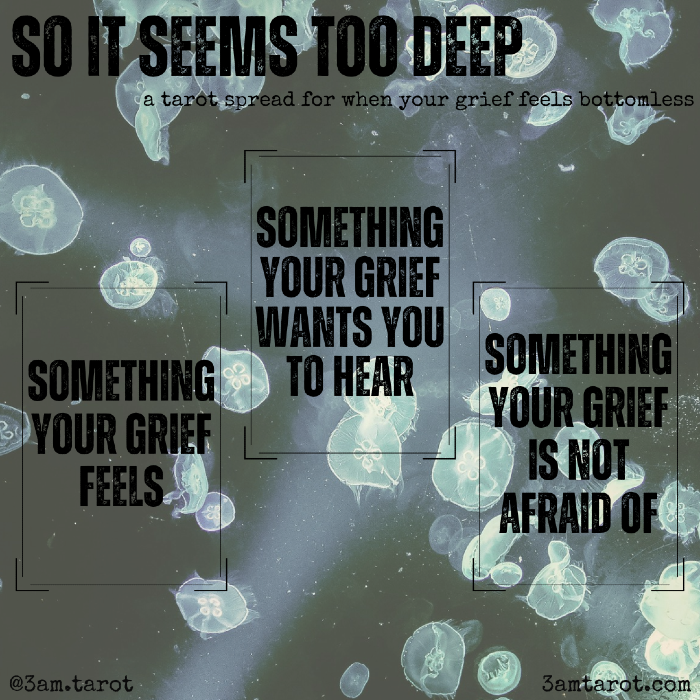
card one / something your grief feels: an emotion, sensation, or reaction that your grief experiences; a tenderness or sensitivity within your grief
card two / something your grief wants you to hear: a truth, reality, observation, or perspective that your grief wants to share with you; an experience or fact that your grief wants to tell you about
card three / something your grief is not afraid of: a fear or anxiety that your grief does not actually feel; something that might not hurt as much as you think
how does it feel to curiously approach your grief? what does it feel like to dip your toes in, to ask questions without expectation, to prioritize patience and slowness and observation?
tarot spreads like this, questions like this, prompts like this, are wonderful to dig into on our own. but if you'd like to do this work in tandem with others, if you're interested in making real space for your grief and transforming it into something with movement, if you know that structure and support would help you stick with this work, i'd love to tell you about two of my upcoming resources:
the first is a completely free tarot for grief journaling event on september 27th, which i'm hosting on zoom. i'll talk about what grief is and how it impacts us, define the various types of grief that we may be experiencing, offer some tarot spreads and reflection questions for you to engage with, and create some space for journaling. afterwards we'll breathe and stretch together, have some time for optional sharing in the chat, share some grief resources to try next, and do a collective card reading to close us out. rsvp here.
the other is river styx, my ten-week community resilience program for transmuting your grief for the world into fierce hope and bold action. participants in the first cohort called this space "deeply cathartic," "profound," "empowering," and "a balm to the soul." i've watched people literally transform through this work, and have been transformed myself again and again. wanna join us? learn more and get on the waitlist here — enrollment opens on september 27th, and the program begins october 4th.
even if you can't participate in either of these spaces right now, i want to encourage you to listen to your grief, to appreciate what it means, and to practice sitting with it regularly. your grief matters, it counts, and it is helping you stay human. don't ignore it 🖤
sending you care, tenderness, and the courage to treat your grief with dignity, friends. more soon.

river styx is for tenderhearted badasses who want to believe in the future again. if you want to learn how to transmute your grief for the world into bold action and fierce hope — without drowning in overwhelm, helplessness, or fear — then this is the program for you.
this is a ten-week, self-paced, resilience-oriented community grief container that includes:
- original audio lessons (including transcripts) delivered straight to your inbox each week, based on the tried-and-true ten-step framework developed by good grief network’s laura schmidt and aimee lewis reau
- recommended tarot cards to work with alongside your lessons, along with new spreads and accessible exercises for tarot readers of any level
- journaling prompts for personal reflection, introspection, and discovery
- suggested somatic exercises to stay grounded, stable, and present
- a library of resources for creating your own personal support plan
- a private digital discord community for sharing, encouragement, and ongoing support
- accountability tools for helping you continue to show up to the work
- five live zoom meetups for checking in and practicing community building
- lifetime access to course content and our co-created grief community
- the flexibility to engage with lessons based on your own schedule and timeline, along with gentle reminders to honor your capacity and personal needs
the program costs $666 or three monthly payments of $222. a higher solidarity rate of $888 is available for participants who are in a financial position to support scholarships for marginalized students.
join the waitlist now to be notified when the program opens for enrollment on september 27th — doors close october 3rd, and river styx officially begins with the first email lesson on october 4th, 2026.
let’s tend our grieving hearts together.





Member discussion