
so you feel guilty calling it grief

hello, friends. i've shared a lot about grief over the last few years, including a series of FLOW essays, a lot of grief-centered tarot spreads, and a personal essay on grief and gratitude on my 40th birthday. over the next week or two i'd love to offer thoughts on a few sticky things that tend to come up again and again when i talk to folks about grief work, in the hopes that i can make this transformative practice feel a little less intimidating.
in part, this is because my ten-week collective grief program river styx begins on october 4th (click here to join the waitlist and get a notification when enrollment opens on september 27th!). but even if you don't participate in that container, grief work is something that is worth thinking about, worth engaging with, worth considering. my hope is that this little mini series can offer you an accessible path into grief work, a lantern to light your way, and a warm hand to hold as you go.
take a deep breath, and let it out slowly. let's get into it.
how do you define grief?
for a lot of people, grief is the very specific heavy, miserable, impossible sensation of loss and sorrow attached to the physical death of a person or creature we loved. and i'm going to be real with you, this particular kind of personal grief is one of the most profound, transformative, life-altering and destabilizing kinds of grief that we can experience in this lifetime. losing someone we love changes us, and there's no denying the impact of a loss like this.
but when we limit our understanding of grief to this one particular experience of loss, it requires us to then minimize the pain, anguish, disappointment, anger, and despair that can come with other challenging or transitional life experiences. events like a rupture or ending of a relationship, the gradual loss of an important friendship, losing a job or not being able to find a job that supports us, people we love splitting up or moving away, having to take on caregiving duties, navigating personal injury or disability or chronic illness, dealing with a major shift in financial status, or struggling to find a sense of purpose or stability are all examples of experiences that can all activate profound personal grief. this isn't even an exhaustive list!
there's a difference between these kinds of personal losses or individual shifts and the broader kind of collective grief that so many of us are carrying around these days. collective grief is easy to discount because it's happening to all of us, through climate catastrophes and fascism and COVID denialism and state violence and economic crashes and genocide and AI takeovers — and some people are really good at denying, compartmentalizing, or numbing themselves to this grief. all of this can mean that if you're struggling, you might feel wildly inadequate as a person, like you're utterly failing or doing something wrong, like everybody around you has a cheat code for coping and you're out of the loop.
you're not doing anything wrong, friend. you're just grieving. and while your grief might feel heavy, exhausting, miserable to manage, and entirely overwhelming, it is also a sign that you still care, that you haven't tuned it all out, that your heart is still soft enough to be broken.
it's really easy to look at what's happening in our cities and our countries and around the world and say that we aren't suffering as much as other people. and listen, for a lot of us, that might be true. i'm part of some communities (queer, trans, disabled) that are being attacked left and right, but i'm also white and live in new york city, which insulates me from other kinds of suffering. just today we've seen horrific miscarriages of justice against Black americans, specifically in the case of nolan wells and the spell of so-called "suicides" (they are not suicides) this year, among other kinds of ongoing racial violence. i am horrified and grieving, and also it would be ridiculous for me not to acknowledge that for some, these injustices are far more personal.
we have to acknowledge all of those things when we think about collective grief. we have to acknowledge that community grief exists in addition to personal and collective grief. we have to acknowledge that we are going to be grieving differently than other people. acknowledging our privilege is part of grief work.
but it's also easy to say that because we maybe haven't been personally impacted in the same ways, that because we maybe haven't lost someone we knew personally recently, that because we maybe aren't part of a specific community that is grieving something more personal to them, that what we're feeling is not really grief. we can tell ourselves that we're just sad, that we're just having a hard time, that it's just *gestures at the world* and eventually it'll be fine again somehow.
it's easy to gaslight ourselves about what we're feeling, to deny its severity. but acknowledging that we are grieving, that collective grief is valid and real, that the horrors we're seeing and experiencing are real, is also part of grief work.
imagine someone drowning in the ocean and arguing that they're just stuck in a little puddle. imagine someone getting carried away by an overpowering current and insisting that they can swim out of it alone. imagine someone getting caught in dangerous rapids and believing that no one else has ever been caught in those same rapids. this is what we do when we refuse to acknowledge the collective grief we're carrying, when we deny all that we're feeling, when we ignore how hard it all is.
your grief counts, friend. it matters. it's impacting you. it's heavy.
and heaping guilt on top of that grief, telling yourself that you shouldn't be grieving somehow, believing that no one else feels the way that you do, isn't doing you any favors. when we insist that our grief doesn't exist, it can make it even harder to navigate. when we argue that we're not underwater, it can make it even more challenging to find our way to the surface. and when we believe that collective grief is an individual problem, it can make it even more impossible to carry.
so what are we supposed to do about it? maybe you're already volunteering in your community, engaging with tarot and other spiritual or therapeutic practices, trying to balance staying informed with not doomscrolling, going on mental health walks, or whatever other rituals for care you've committed to. maybe you're doing your best to cope, to get through each day, to drink your water and care for your pets and pay your bills.
those are all amazing things to do, things that can support you physically and emotionally and mentally. but how do you feel? are all those things you're doing making a difference in your grief?
adding in more habits, more practices, more shoulds can be helpful, to a point — but if it's just feeling like you've got more to do now, like you're creating additional pressure to be okay and heal and be productive, it might be time for another tactic.
and that tactic is intentional, supported grief work.
there are a lot of ways that we can practice engaging with our grief. but in my own practice, and my own experience, i've found that exploring grief alongside others, and with the support of tools like the tarot, can make the journey feel less lonely. learning to sit with our grief, to listen to our grief, to ask our grief what it needs, and listening to others express their own grief for the world and the collective and their communities doesn't just make us feel less alone in the moment — it also, over time, empowers us to transmute all of that heavy, overwhelming grief into movement, action, connection, and real hope for the future.
the aim of this work isn't to somehow "fix" your grief. it's instead to learn to appreciate your grief for what it reveals about who you are, and to engage with your grief in a way that helps you remember your gifts, your courage, and your capacity to dream again.
my grief programs and resources utilize tarot readings, spreads, and activities, along with journaling, reflection prompts, and community discussion spaces in order to offer support and guidance for getting to know our grief. but i've also written a lot about grief, and shared a lot of grief spreads. you can do this work alone, if you want to — and if you'd like to get started right now, grab your deck and try out this tarot spread:
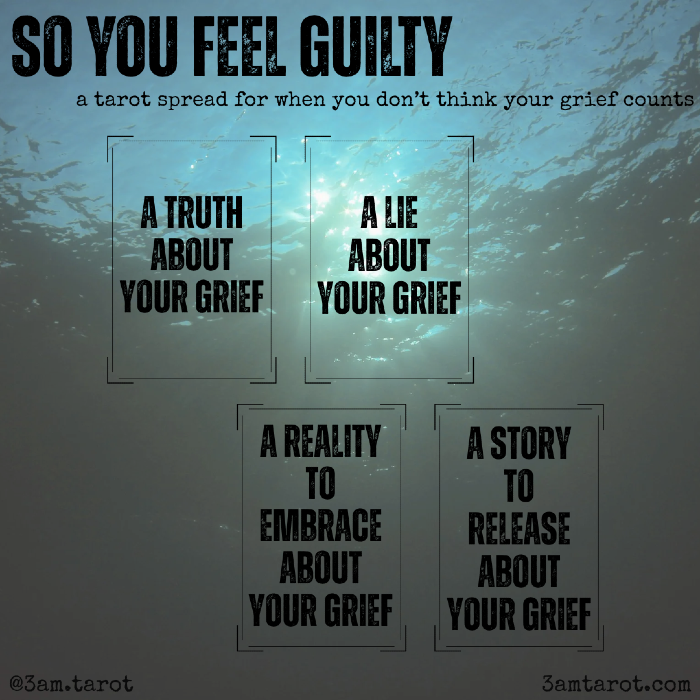
card one / a truth about your grief: something authentic, legitimate, and true about the grief that you are feeling and experiencing
card two / a lie about your grief: something that is not true about your grief; something you believe about your grief that isn't accurate
card three / a reality to embrace about your grief: something that is really happening when it comes to your grief
card four / a story to release about your grief: something you've been carrying about your grief, that it's time to set down
how does it feel to engage with your grief alongside the tarot? what do the cards have to tell you about your own grief? how does looking at your own stories and beliefs about your grief impact what your grief means to you?
tarot spreads like this, questions like this, prompts like this, are wonderful to dig into on our own. but if you'd like to do this work in tandem with others, if you're interested in making real space for your grief and transforming it into something with movement, if you know that structure and support would help you stick with this work, i'd love to tell you about two of my upcoming resources:
the first is a completely free tarot for grief journaling event on september 27th, which i'm hosting on zoom. i'll talk about what grief is and how it impacts us, define the various types of grief that we may be experiencing, offer some tarot spreads and reflection questions for you to engage with, and create some space for journaling. afterwards we'll breathe and stretch together, have some time for optional sharing in the chat, share some grief resources to try next, and do a collective card reading to close us out. rsvp here.
the other is river styx, my ten-week community resilience program for transmuting your grief for the world into fierce hope and bold action. participants in the first cohort called this space "deeply cathartic," "profound," "empowering," and "a balm to the soul." i've watched people literally transform through this work, and have been transformed myself again and again. wanna join us? learn more and get on the waitlist here — enrollment opens on september 27th, and the program begins october 4th.
but even if you can't participate in either of these spaces, i want to encourage you to name your grief, to thank it for being with you, and to start carving out space to listen to it. your grief matters, it counts, and it is helping you stay human. don't ignore it 🖤
sending you love, gentleness, and the courage to engage your grief regularly, friends. more soon.

river styx is for tenderhearted badasses who want to believe in the future again. if you want to learn how to transmute your grief for the world into bold action and fierce hope — without drowning in overwhelm, helplessness, or fear — then this is the program for you.
this is a ten-week, self-paced, resilience-oriented community grief container that includes:
- original audio lessons (including transcripts) delivered straight to your inbox each week, based on the tried-and-true ten-step framework developed by good grief network’s laura schmidt and aimee lewis reau
- recommended tarot cards to work with alongside your lessons, along with new spreads and accessible exercises for tarot readers of any level
- journaling prompts for personal reflection, introspection, and discovery
- suggested somatic exercises to stay grounded, stable, and present
- a library of resources for creating your own personal support plan
- a private digital discord community for sharing, encouragement, and ongoing support
- accountability tools for helping you continue to show up to the work
- five live zoom meetups for checking in and practicing community building
- lifetime access to course content and our co-created grief community
- the flexibility to engage with lessons based on your own schedule and timeline, along with gentle reminders to honor your capacity and personal needs
the program costs $666 or three monthly payments of $222. a higher solidarity rate of $888 is available for participants who are in a financial position to support scholarships for marginalized students.
join the waitlist now to be notified when the program opens for enrollment on september 27th — doors close october 3rd, and river styx officially begins with the first email lesson on october 4th, 2026.
let’s tend our grieving hearts together.





Member discussion