
so grief work seems pretty exhausting

hello, friends. i'm still here talking about grief, because my ten-week collective grief program river styx begins on october 4th, and is currently open for enrollment. but whether you join that space or not, grief work is something that is worth thinking about, worth engaging with, worth considering. my hope is that this little mini series can offer you an accessible path into grief work, a lantern to light your way, and a warm hand to hold as you go.
i've shared a lot about grief over the last few years, including a series of FLOW essays, a lot of grief-centered tarot spreads, and a personal essay on grief and gratitude on my 40th birthday. recently i've been offering thoughts on a few sticky things that tend to come up again and again when i talk to folks about grief work, in the hopes that i can make this supportive and transformative practice feel a little less intimidating. you can read the rest of the essays in this series here.
today i want to talk about the exhaustion that grief can bring — and what we can start to do about it.
take a deep breath, and let it out slowly. let's get into it.
here's the thing: grief really is exhausting. (it's not just you, i promise.)
grief is physically taxing. it is emotionally overwhelming. it is spiritually draining. it is intellectually disorienting. grief can feel like it's taking the best pieces of ourselves away from us, and locking them up tight in a place where we can never access them. it can feel like we're a bad copy of ourselves, some kind of broken imposter stumbling through our days, just trying to keep up while the world spins madly on.
and what's worse, even when we do find a way to sometimes access those good pieces, the playful parts and the hopeful parts and the parts that still know how to connect with other people and create beautiful things and find meaning in the mundane, grief can leave us feeling guilty anyway — like our laughter is a sin, like our pleasure is a crime, like we have to pay for any shreds of joy with penance and misery.
now, not only are we grieving, but we're also feeling ashamed for any moment when we're not actively grieving, or when our grief isn't immediately obvious to anyone who sees us. we're carrying the grief, and the pressure to perform that grief for others.
it's bullshit. but it's also wildly, beautifully human.
because grief is so exhausting, and because grieving is such an exhausting process and state to live in, it stands to reason that we would also expect grief work to be exhausting in the same way. and listen, i'm not gonna pretend that grief work is always gonna be the most energizing, uplifting, or simple thing that you do. sometimes grief work is challenging. sometimes it is heavy. a lot of grief work is listening to our grief and sitting with our grief and giving our grief ways to express itself, and that means that we have to honor all that the grief might share with us. sometimes that might even bring up other things that we then have to process or deal with or think through. sometimes that might activate other feelings that we have to care for as well.
it can feel like interacting with grief in any way is going to be impossibly heavy and hard, requiring every last bit of strength and energy that we have. but i really need you to know that grief work is not the same as grieving.
grieving is something we do whether we want to do it or not. grieving is a reaction, a response, a sensation, and an experience — one that we don't necessarily choose to engage with, that simply happens. grief takes lots of different shapes, shows up when and how it wants to, and can require so much energy just to carry. it's nonlinear, chaotic, unexpected, and demanding.
but grief work is the commitment to transmute that emotion and experience into change, to actively transform ourselves from a grieving creature into someone who can still access hope and optimism, action and change, connection and compassion. it's building a relationship with our grief, learning how to listen to and sit with and tend our grief. and learning to fall in love with our grief, in a way that makes space for joy and compassion and pleasure along with effort, growth, expansion, transformation, and active change.
grief work is the decision to hold fast to the hope, along with the grief. it's a resolution to honor grief's meaning, to make space for the falling apart so that we can learn different ways of putting ourselves back together. grief work is letting grief be part of our life, instead of being an obstacle to that life.
right after we've lost someone we love, or experienced a major disruption, or witnessed a horrific tragedy, it's likely that we'll be too busy grieving to do deep grief work. personal grief exists on its own timeline, with its own twists and turns and cycles and spirals.
sometimes we can do grief work while also in active grief — sometimes it's even surprisingly supportive. but a lot of the time, grief work is something we do once our personal grief isn't quite as sharp or acute, once we have started to metabolize that grief into something else.
collective grief is different. with collective grief, it can feel like grief is simultaneously sharp and worn, fresh and old, active and ongoing. because there is fresh hell every day, along with horrors that have been enduring for years or decades or even centuries, collective grief never really fades. some days are heavier or harder than others, but the grief stays with us, a constant companion.
and that's why collective grief is something that can be so powerful to work with, to process, and to synthesize with other people: because we are all wading through these waters, living in them every single day. none of us are alone in this grief, though it can often feel like it. you are not alone in holding all of this weight, this heaviness, this fear, this overwhelm. there are so many who feel the way that you do right now about the state of the world, and our collective uncertain future.
the trick is in learning to pace ourselves, to build in systems and limits and boundaries and frameworks that help us learn how gently navigate this grief day by day. we're not trying to cross an entire ocean of grief in one go, friends. instead you're building up your stamina, practicing what it feels like, learning what you need, and getting used to the feeling of being with your grief. you're getting familiar with the nuances of your own changing capacity, and creating habits around compassion.
grief work isn't about fixing our grief — it's about finding our flow within the currents and depths of our grief, one day at a time. it's about connecting with other people who are carrying the same grief, who can swim alongside us. and it's about honoring what our grief has to teach us about who we are, what we value, and what we are prepare to fight for.
your grief is a gift: it's a soft heart, a compassionate spirit, a generous soul, an attentive mind. it's proof you still care, proof that this world hasn't destroyed the spark of hope within you, proof that you are still engaged.
that doesn't mean you'll never be tired or overwhelmed again. even long-term grief work practices don't eradicate our grief entirely — because that's not the goal. but when we can recognize why we're so tired, when we can clock that our grief needs some extra care on certain days, when we can direct our grief into activities and efforts that make real change, things start to feel easier, lighter, more hopeful.
your grief doesn't have to just be an impossibly huge ocean. it can also be a river, one that flows and shifts and moves.
and the more you build up your stamina for navigating that river, the less tired you're going to feel — and the more hope you'll be able to carry.
so what can you do right now? where to start, especially if you already feel overwhelmed and exhausted from the mere thought of grief work? grab your tarot deck and pull some cards:
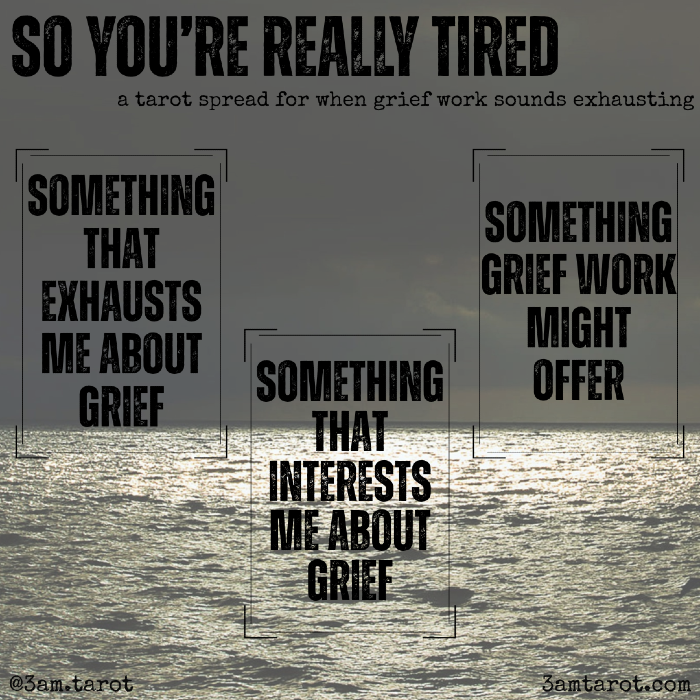
card one / something that exhausts me about grief: an aspect of your grief that you find draining or tiring; something about your grief that takes a lot out of you
card two / something that interests me about grief: an aspect of your grief that you find intriguing or fascinating; something you'd like to explore about grief
card three / something grief work might offer: a possible benefit or shift that grief work could provide; something that grief work could do for you or transform within you
how does it feel to honor your exhaustion when it comes to your grief? what intrigues you about grief, or about grief work? and when you imagine engaging with your grief in a more consistent way, what comes up for you?
tarot spreads like this, questions like this, prompts like this, are wonderful to dig into on our own. but if you'd like to do this work in tandem with others, if you're interested in making real space for your grief and transforming it into something with movement, if you know that structure and support would help you stick with this work, i'd love to invite you to river styx.
river styx is a ten-week community resilience program for transmuting your grief for the world into fierce hope and bold action. participants in the first cohort called this space "deeply cathartic," "profound," "empowering," and "a balm to the soul." i've watched people literally transform through this work, and have been transformed myself again and again. wanna join us? learn more and join us here — the program begins october 4th, and you'll get access to our private discord and some pre-container resources as soon as you sign up.
even if you can't participate in river styx right now, i want to encourage you to listen to your grief, to appreciate what it means, and to remember that you don't have to "solve your grief." your grief matters, it counts, and it is helping you stay human. it's beautiful, and worthy of love. don't ignore it 🖤
sending you care, tenderness, and the courage to listen to your grief with compassion, friends. more soon.

river styx is for tenderhearted badasses who want to believe in the future again. if you want to learn how to transmute your grief for the world into bold action and fierce hope — without drowning in overwhelm, helplessness, or fear — then this is the program for you.
this is a ten-week, self-paced, resilience-oriented community grief container that includes:
- original audio lessons (including transcripts) delivered straight to your inbox each week, based on the tried-and-true ten-step framework developed by good grief network’s laura schmidt and aimee lewis reau
- recommended tarot cards to work with alongside your lessons, along with new spreads and accessible exercises for tarot readers of any level
- journaling prompts for personal reflection, introspection, and discovery
- suggested somatic exercises to stay grounded, stable, and present
- a library of resources for creating your own personal support plan
- a private digital discord community for sharing, encouragement, and ongoing support
- accountability tools for helping you continue to show up to the work
- five live zoom meetups for checking in and practicing community building
- lifetime access to course content and our co-created grief community
- the flexibility to engage with lessons based on your own schedule and timeline, along with gentle reminders to honor your capacity and personal needs
the program costs $666 or three monthly payments of $222 — and anyone who pays in full will get an exclusive tarot reading from me during our ten weeks together!
river styx is open for enrollment right now. doors close october 3rd, and river styx officially begins with the first email lesson on october 4th, 2026. got questions? join me on october 1st for a free, no-pressure open house, or email me anytime.
let’s tend our grieving hearts together.





Member discussion