
so you're underwater & overwhelmed

hello, friends. today, tomorrow, and sunday, i'm going to be sharing some thoughts on grief work, resilience work, and how tarot can help us transmute our big feelings into fierce, consistent action. i know that grief work as a concept can feel really scary for people — if i'm already overwhelmed by the world, how can spending more time with grief possibly help? — but grief work, especially with tarot cards and supportive community by our sides, is one of the best ways to build resilience, gather courage, and show up in the ways that you want to.
before we dive in, a reminder that my big ten-week community grief program, river styx, opens for enrollment on january 26th and officially begins on february 6th. this container combines the tried-and-true ten-step framework developed by good grief network's laura schmidt and aimee lewis reau with my own original tarot prompts, journaling questions, and community-building skills. if collective grief feels impossibly heavy, if you're drowning in overwhelm, if you're desperate to fight for what you value but feel too exhausted to even start, river styx is for you.
when the world is heavy, when terrible things happen day after day, month after month, year after year, it can feel like we're drowning. those feelings of being deep underwater in our grief — the weight, the heaviness, the ways that it can make us feel slow and overwhelmed and disoriented — feel too strong to fight against.
in times like these, grief becomes relentless. it takes so many shapes: anger, fear, sorrow, anxiety, restlessness, frustration, urgency, lethargy, loneliness, desperation, regret. sometimes it's a physical ache in our bones, other times it's a hollow heart or a numb spirit. grief is a constant companion, a specter and shadow, something lurking around every corner.
easier, you might think, to just lock your grief away somewhere. tuck it into a back corner or a dark basement, stuff it into a chest buried deep within your heart and lock it up tight. if i don't look at it, or listen to it, or even acknowledge that it's there, it can't take up any more space. let the grief sink to the bottom, hope that if it's far enough out of sight it can be forgotten entirely.
but the trouble with pushing grief away is that grief is never alone, cannot be fully isolated. grief is firmly, permanently intertwined with other aspects of self, other essential pieces of who we are: hope, joy, love. grief is always tangled up with these wildly alive things, these parts of us that we might feel endlessly hungry for and not understand how to access.
if you lock the grief up tight, you lock the hope up too.
and without hope, and joy, and love, it's hard to feel much of anything. numbness might seem like a sound survival tactic (and it can be, temporarily!), but it's a painful way to function long term. we don't always choose it intentionally, but it's how a lot of people are getting by right now: ignoring the news, ignoring reality, ignoring their feelings. focusing on work and tasks, on the daily grind of labor and bills, on the mundane things that must be done. keeping relationships and conversations surface-level, even with people we love and trust.
i'm not here to tell you that numbness doesn't have its place, or that if you're feeling numb that you're doing something wrong. we're all doing the best we can. but i am here to remind you that no matter how tightly you might think that you have grief locked away somewhere, no matter how deeply you think you've buried it, grief always finds a way to escape eventually.
your grief escapes because it has to be felt. but your grief also knows that you need it, because it's tangled up with all the best parts of you. grief is many things, but it's also another expression of your magic, your sacredness, your aliveness.
instead of pushing grief away, let's befriend it instead.
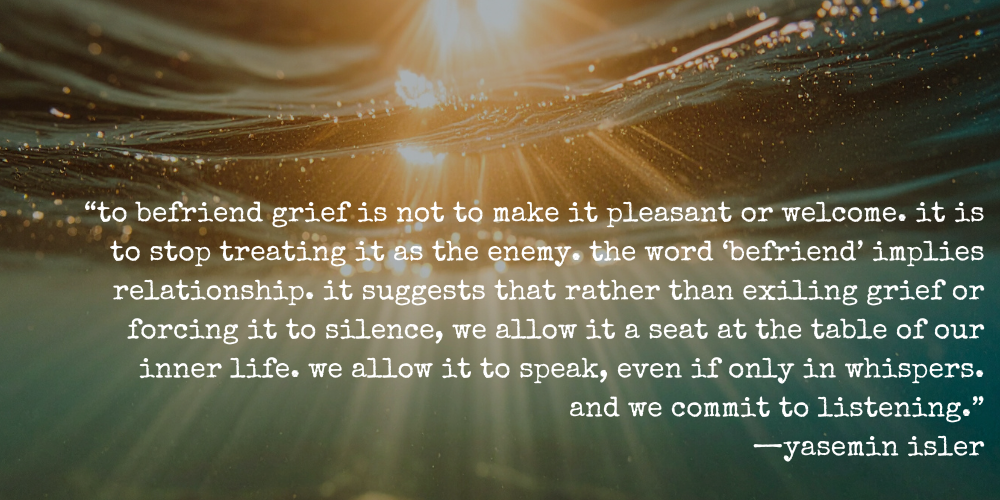
the tricky thing about the kinds of grief that we're all experiencing right now is that personal grief and collective grief need different things — and when we treat collective grief like it's personal grief, we can find ourselves completely underwater.
in addition to the intensity of this world, you might be in the throes of raw, acute, fresh, personal grief. maybe you've lost a loved one to physical death, or you're going through a painful divorce. maybe a friendship or relationship of some kind has ended, after a difficult rupture or a long and slow separation. maybe you've had to change jobs or homes or communities, maybe you've had to say goodbye to a dream or expectation, maybe you've realized that something about you has fundamentally changed. personal grief can take so many forms, all of them valid and intimate and painful.
but collective grief is also here, churning in the background: the polycrisis and all that it entails. fascism and state violence. ICE raids and concentration camps and disappearances. wars and genocides. shattered worldviews and the realization that whiteness and privilege will not protect us. all of these catastrophes and many more stack as collective trauma and grief, an experience that we are all sharing whether we realize it or not.
while the medicine for personal grief and loss is often time, space, and memory, collective grief does not fade on its own so easily. there is always something new to grieve during a polycrisis, something more to add onto the ever-growing pile. collective grief is continuous waves, an endless current that can knock us off our feet if we aren't paying attention.
i'm not saying any of this to bum you out or make you feel hopeless. i'm saying it because naming the hard things helps us all feel less alone. i'm saying it because you are not "failing to cope" or somehow "bad at being a person." if it feels like you're drowning every single day, if you cannot seem to keep your head above water when it comes to paying attention and caring for yourself, if nothing you do seems to be enough, it's because you're grieving something that keeps dying over and over again. we all are.
you're not burned out, you're living in a crumbling empire. you're not dysregulated, you're witnessing horrors every single hour of every single day. you're not a bad person, you're surviving the inevitable conclusion of a long-term white supremacist project. these common framings are all ways of turning institutional failure into individual responsibility, and i really need you to understand that systemic and foundational corruption is the actual problem here.
we cannot "one easy trick" or "i just need a month off" our way out of this moment. we have to face things head-on and build ongoing, long-term, supportive systems for survival, community, and hope. we have to acknowledge the severity of what we're dealing with, so that we can imagine new and different kinds of futures. we have to claw our way to the surface of our grief, so that we can truly recognize what we're dealing with and what else lives in these deep, mysterious waters.
and you might not like it, but an essential, even urgent part of facing things is starting to regularly acknowledge our grief, in a real and sustainable way, on our own and with other people.
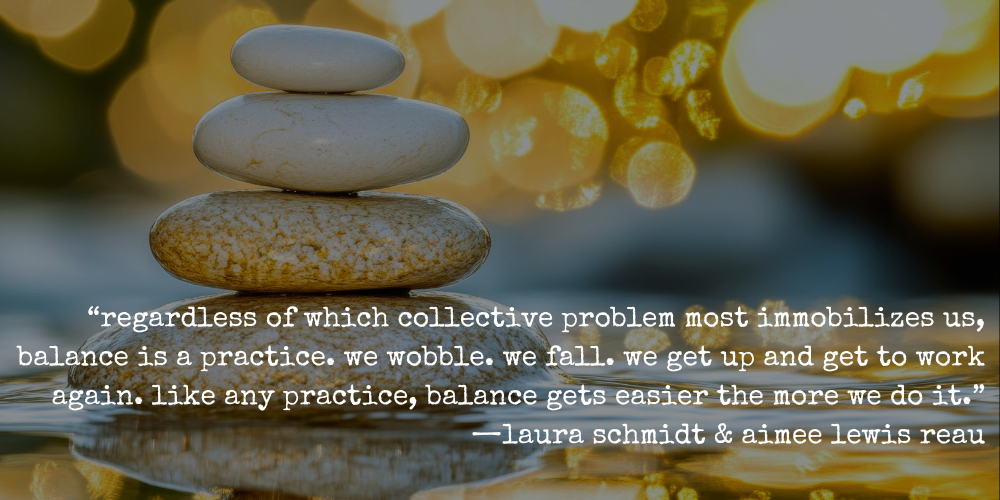
if you've never done grief work before, you might think that it's just active grieving: diving straight into the deep end, surrendering to the heaviness, forcing ourselves to actively feel it all. and while the experience of acute mourning can be a necessary or unavoidable stage of the process, grief work is actually resilience and reconnection, honoring transformation, imagination and dreaming and activating hope. grief work is about acknowledging our grief, listening to our grief, creating ongoing space for our grief, and learning to walk hand in hand with our grief on a regular basis.
this isn't about "fixing" your grief — it's about falling in love with what it represents, and letting grief help you get back to your life alongside it.
your grief tells you what you value, what you yearn for, what you care about. it tells you what you hope for and dream about, what you are devoted to, what you envision for the future. your grief is the blood in your veins, the dirt under your fingernails, the throbbing of your heart. it's the key to your soul, the truth of your magic.
your grief is sacred, wild, the most tender part of you. and it is worthy of your care, your attention, and your compassion. your grief means you're alive.
once you start to treat your grief like a gift instead of a burden, once you allow your grief to whisper what it needs, you can let your grief teach you how to envision a more hopeful, beautiful kind of future — not only for yourself, but for the collective.
because that's the thing: when you let your grief take up space, breathe and move and flow, it makes room for other things. your joy returns, your hope emerges, your capacity for love expands. your ability to grow and change, to learn and listen, to show up fiercely and fight for what you believe in becomes so much easier.
when you welcome in your grief with open arms, the hope and the love and the joy all come too. and i want that for you, friend. i want that for all of us.

i'm not going to pretend that grief work doesn't require effort from you. grief can be scary to hold, especially if you've spent a long time pushing it away or denying its existence or downplaying its impact on you. and if you're someone who associates a lack of comfort with a lack of safety, if you struggle with uncertainty, if you greatly prefer to be in control, grief work might seem really challenging.
but we don't have to dive headfirst into the biggest, hardest feelings right now. we don't have to drown in overwhelm or constantly get lost in the depths. we can start gently, thoughtfully, by simply listening. we can begin, of course, with tarot.
i'm going to share a new tarot spread with you, but i'm also going to encourage you to try using it in a few different ways. the first way you can use it is just as it's written — as a tarot spread, for a personal tarot reading. shuffle the deck up well, pull one card for each position, and interpret these cards as answers to your questions around grief. let the cards offer you some insights and advice into the grief you're experiencing right now, and pay attention to what comes up for you as part of this work.
the second way that you can use this is as a set of four interconnected journaling prompts. consider each prompt its own question, and spend some time working to answer them on your own. you may find that the answers you find on your own are very similar to what the cards bring up — or you might find that the cards observe something totally different that also resonates!
but the third way to use these, the way i want you to really challenge yourself to try out, is to use these spreads with someone you love and trust. you can use them as conversation starters, you can each journal privately for a bit and then share what comes up, or you can use this as a spread and do tarot readings together. but i want you to try bringing someone else into this work — someone you know could also use it, someone that you feel comfortable getting deep and honest with.
grief work is really important, but it is so much easier, and often even more effective, in community. talking with someone, sharing with someone, being witnessed by someone and witnessing someone in return — you will be amazed at the impact it has on you when you share this burden of grief with someone else. this isn't about trying to solve each others' problems or telling each other that it'll all be okay. this is instead about holding the grief together, and acknowledging that you're both feeling it.
what does it feel like to listen to your grief? what does it mean to listen to someone else's grief, and to let them hear yours too?
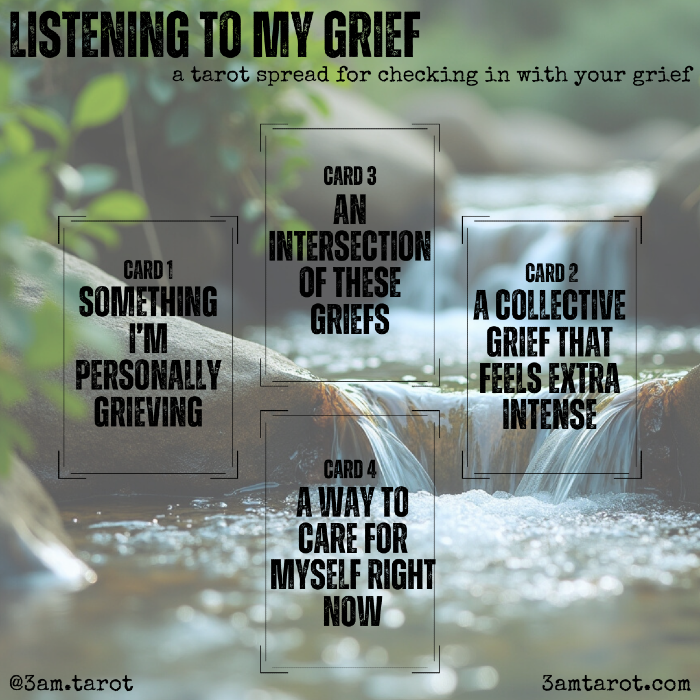
card one / something i'm personally grieving: a specific grief experience or loss that i am holding that feels individual, intimate, or not shared by the broader collective
card two / a collective grief that feels extra intense: a specific grief experience or loss that i am really grappling with that is impacting the collective
card three / an intersection of these griefs: a detail, impact, value, or other aspect where these two kinds of grief overlap or intersect; something these griefs share
card four / a way to care for myself right now: something you can do right now to show yourself care, tenderness, or graace
whatever comes up as a result of this work, however you engage with this tarot spread, i want you to practice showing yourself compassion. don't judge yourself for what you hear when you listen to your grief — just hold on to it. make space for it. what does it feel like to do this practice? what is your grief trusting you with? and what can you observe about yourself and your values, simply by giving your grief some room to share?
this is the end of the essay. but it's not the end of this work — it's only the beginning. if you're interested in trying these kinds of spreads and exercises out with other people, if you're curious about how it might feel to spend some dedicated time listening to your grief, i'd love to invite you to join me for a completely free virtual tarot journaling event january 26th at 7pm EST.
and if this event really appeals to you, if this kind of work is already opening something up inside of you, if you'd love to spend more time in supportive community exploring your grief:
river styx is for tenderhearted badasses who want to believe in the future again. if you want to learn to transmute your grief for the world into bold action and fierce hope — without drowning in overwhelm, helplessness, or fear — then this is the program for you.
this is a ten-week, self-paced, resilience-oriented community grief container that includes:
- original audio lessons (including transcripts) delivered straight to your inbox each week, based on the tried-and-true ten-step framework developed by good grief network’s laura schmidt and aimee lewis reau
- recommended tarot cards to work with alongside your lessons, along with new spreads and accessible exercises for tarot readers of any level
- journaling prompts for personal reflection, introspection, and discovery
- suggested somatic exercises to stay grounded, stable, and present
- a library of resources for creating your own personal support plan
- a private digital discord community for sharing, encouragement, and ongoing support
- accountability tools for helping you continue to show up to the work
- three live zoom meetups for checking in and practicing community building
- lifetime access to course content and our co-created grief community
- the flexibility to engage with lessons based on your own schedule and timeline, along with gentle reminders to honor your capacity and personal needs
the program costs $666 or three monthly payments of $222. a higher solidarity rate of $888 will also be available for participants who are in a financial position to support scholarships for marginalized students.
to celebrate this first cohort of river styx grievers, all participants will receive a downloadable digital collection of brand new, original tarot spreads. plus, the first four people who sign up will also be able to choose one spread for this collection for me to use in a personalized mini audio tarot reading, as an extra thank you!
join the waitlist now to be notified when the program opens on january 26th — doors close february 5th, and river styx officially begins with the first lesson on february 6th, 2025.
let’s tend our grieving hearts together.
i sincerely hope that these words have given you some strength, courage, encouragement, and support in these heavy times. sending you love, power, and resilience, friends. more tomorrow.





Member discussion