
so you're hovering at the surface

hello, friends. yesterday i wrote about the feelings of being deeply underwater in our grief — the weight, the heaviness, the ways that it can make us feel slow and overwhelmed and disoriented. today we're going to talk about what it means to hover at the surface of our grief, how we can get a wider perspective on grief in general, and some ways that tarot can help us navigate grief in an intentional and supportive way.
a quick reminder that i'm hosting a completely free virtual tarot journaling event on monday, january 26th at 7pm EST. i'd love for you to join us.
now, let's talk about grief, stories, and tarot.
your grief has a story to tell.
part of the reason that i have fallen in love with grief work is that i love stories. i love narratives, i love cause and effect, i love friction, and i love journeys. i find it so intoxicating and engaging to witness growth and discovery, crossroads and choices, the impacts of seemingly minor decisions, the intersections of characters and challenges. tracing the path, seeing what happens, being surprised by twists and turns — i love it all.
and the older i get, the more useful i find stories and cycles to be when it comes to processing emotions, reckoning with obstacles, and moving through periods of transformation.
one of my favorite stories of all, a story with dozens of stories buried inside of it, is the story of the tarot. the tarot is so many stories at once, overlapping tales of creative sparks and deep roots, open hearts and sharp minds, growth and transition and endings and rebirths. between the fool's journey through the major arcana, the four elemental cycles in the minor arcana, and the families and figures that grow and change in the courts, the tarot has so many stories to tell us. and it also reminds us that we are in many stories at once: stories of love and community, truth and perspective, creation and destruction, growth and decay. we are in simultaneous stories, overlapping stories, contradictory stories, all the time.
it feels natural, practical even, to use tarot to help us tell our own stories. and when we're approaching our own grief narratives, grief experiences, grief cycles, and grief challenges, the tarot is a beautiful tool and language to reach for in helping us find the words, the feelings, and the stories we need to understand what we're holding.
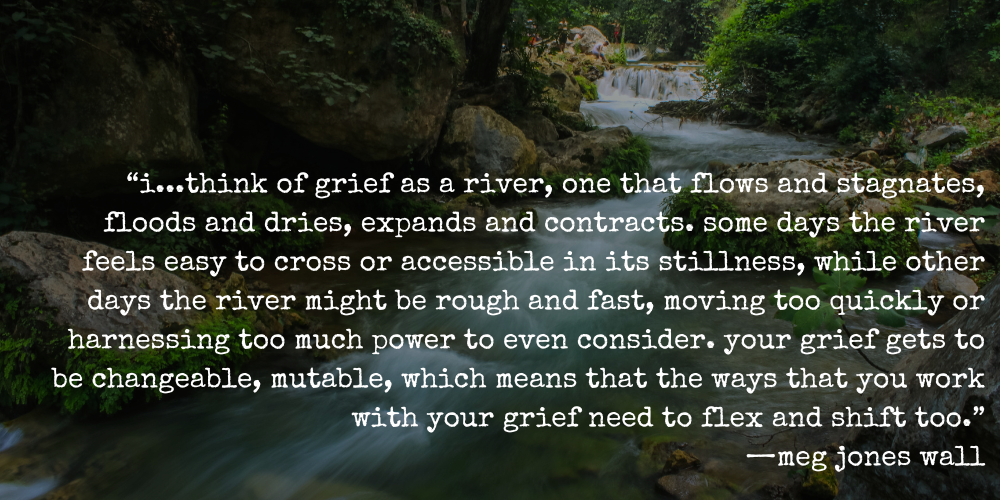
as i've shared in previous essays and resources, grief is a complex and complicated thing. collective grief in particular can be deeply disorienting and challenging to process, leaving us feeling like we're not sure which way is up. it's really important to acknowledge how mutable grief is, how individual it can be even when we're grieving something that impacts the many. like water itself, grief can be calm or rough, sweeping or stagnant, dragging us down or pulling us forward. day by day, week by week, grief has many forms — all of them valid.
some days, your grief will scream and cry, demanding your attention, refusing to let you focus on anything else. it might feel like you're getting dragged down into the depths, like you can't breathe, like everything is too heavy and too powerful and too much. especially in periods of sharp, fresh loss, this experience of grief can feel a bit feral, desperate, all-consuming.
other days, your grief will feel harder to listen to. some days are heavy or hectic, exhausting or distracting — your grief might bury itself, quiet itself, not wanting to be seen or heard. on those days we might find ourselves climbing to the surface, able to more easily observe and attend to the currents moving underneath. when we sit at the surface of our grief, when we are partially in and partially out of the depths, it can be a little bit easier to listen to it, to understand it, and to see the bigger picture of how our grief interconnects us. at the surface we can more easily see the broader scope, and the stories that have brought us here.
and still other days, you might feel like you're not grieving at all. joy and hope might feel easy to access, laughter might spill from your lips, and you might feel like there is possibility for deep magic in the present and the future after all. on these days, you might remember what you're living for, what you're fighting for, what kind of future you're imagining and working towards. and frustratingly, sometimes on those days you might experience guilt or shame for finding beauty in this world, for not being more upset in that precise moment.
all of this is normal. you're not broken for getting lost in your grief sometimes, just like you're not a villain for laughing or feeling okay sometimes. grief is a spiral, a complex story told in fragments, a labyrinth with shifting walls, a place where hope and joy and love also dwell. it's not linear or clear and constantly bucks expectations. grief can surprise us with its intensity or with its retreat, with its urgency or with its stillness. sometimes it's calm when we expect it to react, other times it pops up out of nowhere and catches us off guard.
our grief is constantly transforming — and it also transforms us.
this is why recognizing the story of our grief, the patterns of our grief, the realities of our grief, and the chaos of our grief can be helpful. it's more than just trying to climb to the surface so that we can breathe with ease — it's also about knowing ourselves and re-meeting ourselves, through self-discovery and observation but also through conversation, community spaces, and witnessing.
and this is why tarot is so good for grief work.
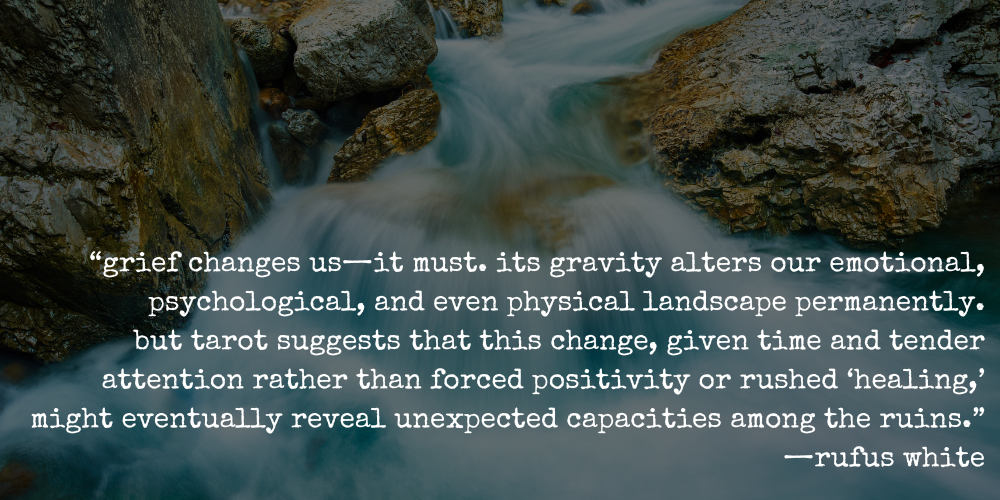
tarot can help us name patterns, trace them, create space for them. tarot can support us in identifying our feelings when words are too hard, can offer us truths and insights when they feel too challenging to clarify on our own, can call us out if we get too attached to intellectualizing our grief instead of listening to it. and tarot can also suggest archetypes and figures for us to work with gently, as companions and guides for our grief journeys — or even as personifications of our grief, for us to talk with and walk with.
through readings and journaling and archetype work, tarot helps us sit on the surface of our grief and look at the vast expanse of where we've been, where we are, and where we might go. not as a way of fully abandoning experiencing our emotions — but rather as a way of naming and processing where we are in the journey, obstacles and all.
tarot is also really excellent at building resilience. it helps us slow down, pace ourselves, and sift through feelings of uncertainty, discomfort, and mystery in an approachable, everyday kind of way. every time we read tarot and let ourselves be confused, every time we accept the fact that we might not know something for sure, we build up our capacity and our resilience — qualities that are absolutely necessary for engaging with this world and its many challenges.
no matter how your grief may feel, no matter what your grief may crave, no matter what your grief might be trying to tell you, there's a card for that, a story for that, a cycle for that. and honestly, thank god, because sometimes language is simply too difficult to access. especially in those tough days that are heavy with grief, tarot can be an anchor to steady you, a compass to guide you, or even a ferryman to accompany you forward.
just as tarot is 78 pieces of story that we shuffle and mix, grief is a strange jumble of simultaneous experiences that layer and intersect. sometimes it can feel like we're holding contradictions and impossible answers, other times it feels clear and obvious what is needed. again, all of this is normal.
even if you're not someone who typically keeps a journal, if you find yourself getting regularly discombobulated within your grief i would highly recommend beginning a grief journaling practice. this can be a digital document or section of your notes app, it can be a bound diary or loose pieces of paper, it can be a collection of voice notes or email drafts or doodles or bullet points or whatever works for you and your brain.
use this journal to check in with your grief, whenever you think of it. ask your grief how it's feeling, what it needs, where it's focused. record your tarot readings here, your thoughts and feelings, your fears and hopes. take note of anything that feels relevant. over time, you might find some patterns — subtle and quiet though they may be. you may see some common threads in how your grief expresses itself, when it feels extra tender, when you can hear it more clearly. you might also start to notice when checking in with your grief feels okay, and when it doesn't occur to you or feels like something you actively want to avoid.
all of this is grief work.
it's not about judging yourself for your grief, or trying to fix it. it's not about denying the painful parts of the grieving experience or pretending everything is fine. it's about developing a habit of observing grief, honoring it, letting it take up space in whispers or screams. it's about seeing the pieces of the story, the parts of the experience — not so that you can weave a beautifully linear tale with a happy ending, but instead so that you can start to understand where your grief dwells, what comforts it, and where it might want to take you.
and if you want some additional ways to check in with your grief, or learn how to see it in some new ways, i've got some new tarot spreads for you.
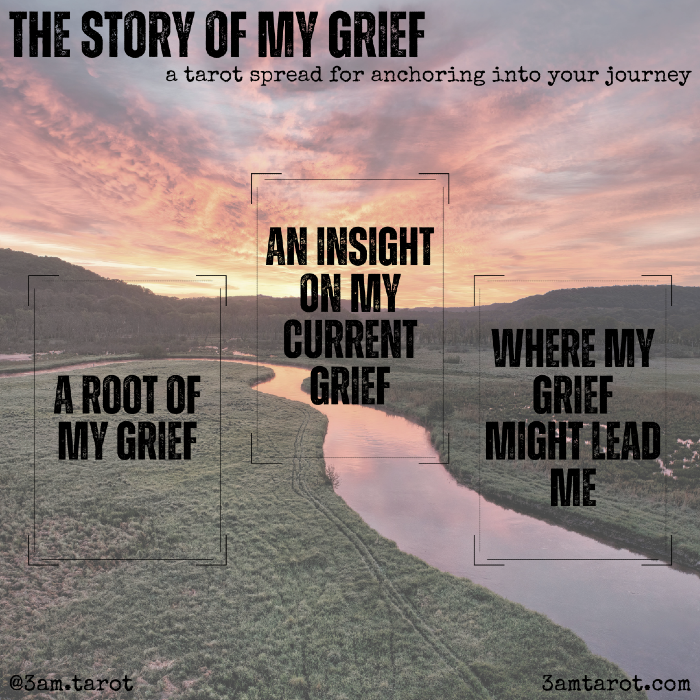
the story of my grief: this tarot spread may help you connect some dots between past, present, and future iterations or experiences of grief. it can also help you observe the ways that your grief moves, through you and around you.
card one / a root of my grief: something that anchors or tethers my grief; an early grief experience; an aspect of my grief that feels foundational or significant to me
card two / an insight on my current grief: an observation or truth about the grief i'm feeling right now; something to note about today's grief
card three / where my grief might lead me: a potential horizon that you may be moving towards; a destination that your grief might be able to help you reach
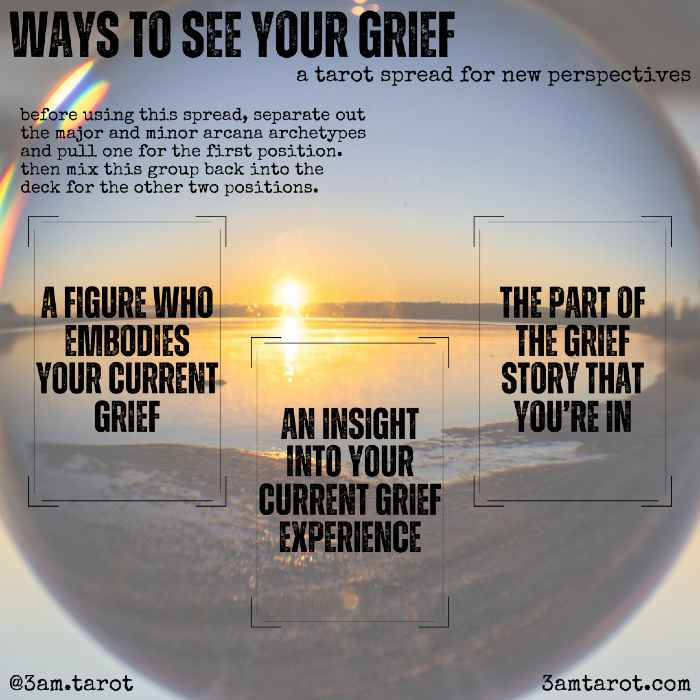
ways to see your grief: if you're using a deck with figures on every card, you might prefer to just use the full deck for each of the three positions on this spread. but i'd recommend separating out the major arcana archetypes (and if you like, also the minor arcana court cards), shuffling that group of cards well, and pulling one for the first position. then mix that archetype group back into the rest of the deck, shuffle well, and pull the other two card positions to complete your reading.
this spread offers you three ways to see your grief: as a figure, as a general insight or observation, as well as a story beat. these are simply suggestions — one might resonate more than another, or they all might speak to you in different ways. use this spread when you're having trouble recognizing your grief, or when you want to connect with your grief in new ways.
card one/ a figure who embodies your current grief: an archetype who represents the shape that your grief is taking right now; a way of seeing your grief that might feel relatable, conversational, or like a steady companion to walk with
card two / an insight into your current grief experience: a truth or reality about your grief that you might not be seeing right now; something that the cards want you to recognize about your current experience of and emotions in grief
card three / the part of the grief story that you're in: a way to anchor your grief in a particular moment of the cycle; the part of the narrative that you're currently moving through
as you observe your grief through journaling and tarot readings, as you look into the clear waters and the shimmering surface of your grief, pay attention to the version of self that you see in the reflection. honor the changes you may be experiencing, the stagnation you might be noticing, the roots and figures and insights and stories that your grief is offering to you. what is your grief holding out with gentle hands, hoping that you'll receive? what is your grief holding tightly, waiting for you to notice? and where might your grief need some tenderness, some compassion, some consistent care?
this is the end of today's essay. but it doesn't have to be the only grief work that you engage in. if you're interested in trying out some spreads and exercises with other people, if you're curious about how it might feel to spend some dedicated time listening to your grief, i'd love to invite you to join me for a completely free virtual tarot journaling event january 26th at 7pm EST.
and if you're loving this essay series, if this kind of work is already opening something up inside of you, if you'd love to spend more time with supportive community exploring your grief:
river styx is for tenderhearted badasses who want to believe in the future again. if you want to learn to transmute your grief for the world into bold action and fierce hope — without drowning in overwhelm, helplessness, or fear — then this is the program for you.
this is a ten-week, self-paced, resilience-oriented community grief container that includes:
- original audio lessons (including transcripts) delivered straight to your inbox each week, based on the tried-and-true ten-step framework developed by good grief network’s laura schmidt and aimee lewis reau
- recommended tarot cards to work with alongside your lessons, along with new spreads and accessible exercises for tarot readers of any level
- journaling prompts for personal reflection, introspection, and discovery
- suggested somatic exercises to stay grounded, stable, and present
- a library of resources for creating your own personal support plan
- a private digital discord community for sharing, encouragement, and ongoing support
- accountability tools for helping you continue to show up to the work
- three live zoom meetups for checking in and practicing community building
- lifetime access to course content and our co-created grief community
- the flexibility to engage with lessons based on your own schedule and timeline, along with gentle reminders to honor your capacity and personal needs
the program costs $666 or three monthly payments of $222. a higher solidarity rate of $888 will be available for participants who are in a financial position to support scholarships for marginalized students.
to celebrate this first cohort of river styx grievers, all participants will also receive a downloadable digital collection of brand new, original tarot spreads. plus, the first four people who sign up will also be able to choose one spread for this collection for me to use in a personalized mini audio tarot reading, as an extra thank you!
join the waitlist now to be notified when the program opens on january 26th — doors close february 5th, and river styx officially begins with the first lesson on february 6th, 2025.
let’s tend our grieving hearts together.
grateful that you're here, grateful that you're reading, grateful that you're listening. grateful that you're still showing up, grateful that you're fighting back, grateful that you're pushing through these difficult days. grateful for your magic, your care, your kindness, your compassion. grateful for you.
i'll be back with another essay tomorrow, and in the meantime i'm sending you love, courage, and safety.




Member discussion