
so you want to feel better

hello, friends. i’ve been writing for the last few weeks (and months, and years if i’m being honest) about grief — not only the deeply personal and intimate griefs that we experience when a loved one dies or a major disruption changes our world, but also the collective grief that we are all experiencing witnessing climate change, genocides, billionaires, white supremacist systems, fascism, imperialism, those fucking epstein files and all that they represent, and the other systemic collapses that we are being impacted by and living through on a daily basis.
grief isn’t always the first label that comes to mind when we think about all of the catastrophes and horrors that we’re seeing and experiencing — yet grief, specifically collective grief, is exactly what we’re experiencing.
today i want to talk about what grief work actually does — the literal, practical impacts that it can have on you. (and yes, it can literally make you feel better.) i’m going to offer some journaling prompts and a tarot spread that you can use right now to start investigating and listening to your own big feelings, including grief. and i’m also going to remind you that my ten-week collective grief program river styx begins on friday, and we’d love to have you.
take a deep breath, and let it out slowly. ground your feet into the floor, and notice what it feels like to press down and find stability within your body. sip some water, and pay attention to the liquid moving down your throat. roll your shoulders, relax your jaw.
and if you want to intentionally set a vibe for your reading time, here’s the song i listened to while i wrote this piece.
first, a quick reminder: collective grief is different than personal grief, although they can absolutely overlap and intersect. personal grief is something that is specific to your life and lived experience: the death of a loved one, the loss of a place or a job or an opportunity, the end of a relationship, the shattering of a dream or belief or worldview. collective grief, on the other hand, is something that is shared by the many: that sick feeling you get when you turn on the news, the horror you feel when think about climate change, the uncertainty you experience around the future. collective grief is a collective response to the breaking down of systems and institutions, and it’s an extremely legitimate and logical reaction.
depending on your identity and lived experience, you might also experience what i call community grief: that is, grief that is specific to a subset of people, and is both personal and collective. racism, transphobia, ableism, ancestral trauma, etc – these are griefs that are unique to specific groups of people. as a white person, the grief that i feel about a racist attack is very different than the grief experienced by someone who is part of the racial group being attacked, and it's essential to acknowledge this in grief work too.
these kinds of shared grief, within communities as well as our in broader global collective, require a different approach than personal grief. where personal grief is best tended with time and patience and gentleness (and is much more commonly discussed and understood across cultures, even if some cultures like the united states avoid it as much as possible), time doesn’t make much of a difference when it comes to collective grief. after all, we’ve got horrific breaking news stories every day, with grief coming in constant waves — there is no break to catch.
collective grief does not simply resolve itself. we cannot perpetually tuck it away and hope it disappears by magic. instead, this grief is something we must acknowledge and move through, so that it doesn’t leave us trapped in paralysis and overwhelm.
so what does it look like on the other side? what happens when we actually do the challenging work of learning how to navigate our collective grief?
you will feel better, honestly — but it’s also a lot bigger than that.
grief work, and specifically the proven ten-step framework that serves as the foundation of my river styx program, actively helps us become better people, better partners, better parents, better stewards of this planet, and better community members. grief work helps us release overwhelm and exhaustion, gives us energy and resilience, and empowers us to actually show up in our lives again.
engaging with our grief, tending our grief, listening to and learning from our grief, reconnects us with ourselves and the people around us. and having methods of honoring our feelings without trying to fix them helps us to quite literally get unstuck.
if you’re tired of being exhausted and overwhelmed all the time, if you’re sick of wringing your hands and feeling like there’s nothing you can do to stop the endless pain and violence around us, if you’re frustrated that it feels like no one around you feels as deeply as you do, grief work can really help you feel more energetic, more focused, more effective, and more connected.
my river styx program is designed to help you gently move through grief work at your own pace, with other grievers at your side, using tarot and journaling and slow space to fundamentally shift your relationship with your heavy feelings and transmute those feelings into meaningful action. if that sounds like what you’re looking for, i’d invite you to check it out, pull some cards about it, and consider whether this might be a supportive place for you to grow.
still not sure about grief work? i get it. grab your journal and consider the following prompts:
-what does grief mean to you, and where did that definition come from? what do you associate with grief? what scares you about grief, and why?
-what would it feel like to reframe your deep feelings of anger, sorrow, restlessness, urgency, frustration, horror, shock, and/or exhaustion as connected to grief for the collective? how does that language shift the way you understand your own emotions and experiences? what kinds of compassion or kindness might this framing unlock for you?
-how are you feeling right now? what comes up for you when you consider your current emotional state? what are those feelings connected to, or what might be their source?
-what would it feel like to give yourself permission to feel something, without trying to fix it? what would it mean to simply honor the problem, rather than scrambling for solutions?
these kinds of questions can serve as an introduction to grief work. it’s not about drowning in the rivers and oceans of grief within you — it’s instead about beginning to engage with your grief, giving it permission to exist, and paying attention to what it might reveal about who you are and what you care about so that you can navigate that grief with intention and clarity.
feeling sticky or in need of grounding after journaling and reflecting? try some gentle breathwork, take a few moments to stretch, listen to a short meditation, or put on a favorite song and move your body to the rhythm in whatever way feels good for you.
how do you feel? there are no right or wrong answers — this is about practicing paying attention, and being compassionate about whatever you see and feel.
and if you’d like to bring your tarot cards into it, use this three-card tarot spread as a structure for a regular tarot reading, or choose cards intentionally to explore how you feel using the language of tarot:
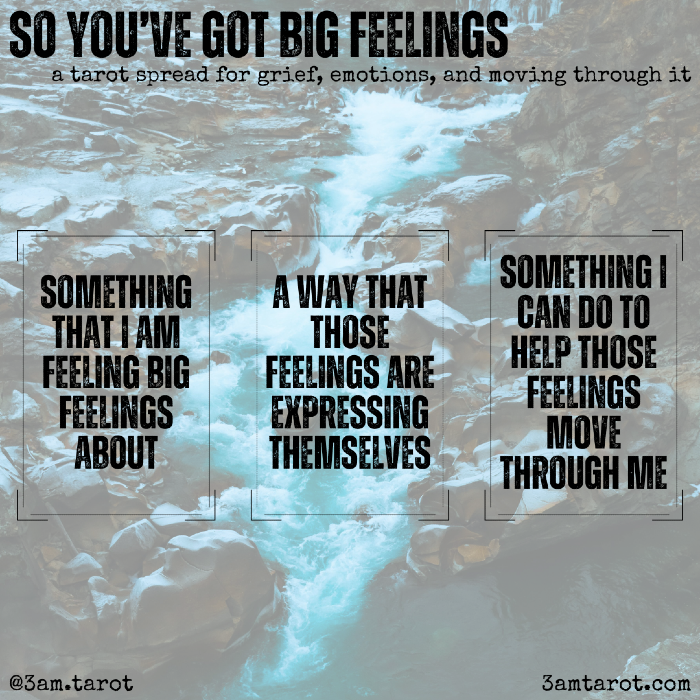
card one / something that i am feeling big feelings about: an event, situation, conflict, challenge, or update that is bringing up heavy emotions or strong reactions within you
card two / a way that those feelings are expressing themselves: the actions, choices, words, thoughts, or sensations that show you how your big feelings are showing up in your life right now
card three / something i can do to help those feelings move through me: advice or a next step; an action or inaction that will give your emotions space to breathe and move rather than staying stagnant or suppressed
this is grief work, friend. this is where we begin — by acknowledging where we are, by being honest about what’s going on in the world, and by allowing ourselves to recognize that what we’re feeling is grief.
as we move firmly into 2026, as we consider all that is changing and collapsing, grief work can help us imagine new, more hopeful futures — and can also give us the energy and focus we need to actually make them happen, day by day.
if you'd like support from me and other grievers to navigate the choppy depths of grief, my river styx program begins on friday february 6th.

river styx is for tenderhearted badasses who want to believe in the future again. learn how to transmute your grief for the world into bold action and fierce hope — without drowning in overwhelm, helplessness, or fear.
this is a ten-week, self-paced, resilience-oriented community container that includes:
- original audio lessons (including transcripts) delivered straight to your inbox each week, based on the tried-and-true ten-step framework developed by good grief network’s laura schmidt and aimee lewis reau
- recommended tarot cards to work with alongside your lessons, along with new spreads and accessible exercises for tarot readers of any level
- journaling prompts for personal reflection, introspection, and discovery
- suggested somatic exercises to stay grounded, stable, and present
- a library of resources for creating your own personal support plan
- a private digital discord community for sharing, encouragement, and ongoing support
- accountability tools for helping you continue to show up to the work
- three live zoom meetups for checking in and practicing community building
- lifetime access to course content and our co-created grief community
- the flexibility to engage with lessons based on your own schedule and timeline, along with gentle reminders to honor your capacity and personal needs
the program costs $666 or three monthly payments of $222, and the first lesson will be emailed to you on friday, february 6th.
whether you're able to join me for this first river styx cohort or not, i sincerely hope that these insights, journaling prompts, and tarot questions can support you in engaging with your grief in a consistent, supported way.
and if you've got questions about river styx, or want to talk about grief work more generally, feel free to email me — i'd love to hear from you. more soon.





Member discussion